Showing posts with label mynas. Show all posts

gigantic urli in the temple courtyard of the elephant village at Punnathur Kotta, near Guruvayoor, Kerala

Urli is a round flat bottomed vessel made in copper, bronze, stone or clay, usually in south India, and used for cooking or decorative purposes. One usually sees Urlis in small or medium sizes, rarely more than four feet in diameter. But this one took my breath away. I came upon it suddenly, and it was the only item in the temple courtyard at Punnathur Kotta. There seemed to have been an attempt to grow lilies or lotus blooms in it but it did not seem to have succeeded.

Punnathur Kotta is an elephant village, housing more than fifty elephants easily. It is located barely 3-5 kms near Guruvayoor, the well known temple to Shri Krishna, in Kerala. The elephants at Punnathur Kotta are regular participants of the temple festivals at Guruvayoor and Thrissur. This temple within the Kotta is almost like a museum but does not have anything remarkable for pilgrims or tourists to linger about and appreciate fully.

I took a series of photographs of this gigantic urli, and kept moving about to get a proper perspective behind the large vessel, to compose the picture. At that moment, I realised that I was the only person moving about this place, and all the other hundreds of pilgrims and tourists were happily moving about the elephants outside the temple. It was silent except for the sounds of trumpeting elephants and the calls of crows, mynas and babblers. Taking advantage, I sat there quietly for some time, just listening to the sounds coming in to the courtyard, with the silent urli as my only witness.


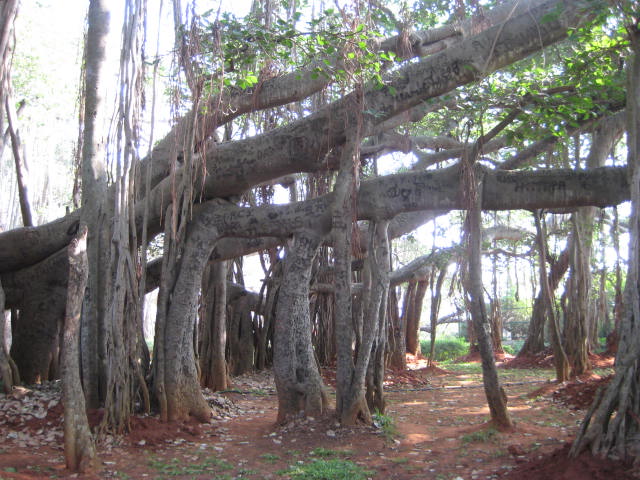
the big banyan tree on the Bengaluru to Mysuru highway, Karnataka

There is a cut off on the Bengaluru to Mysuru highway, to a village nearby. The big banyan tree as it is actually called, is located here, barely within an hour's drive out from Bengaluru. Its quite 'big', and spread out over nearly 2 acres of land, I think. The main trunk is in the centre of the plot that is protected, beautified and managed, by strangely, the Bank of Maharashtra. Way down south, in Karnataka, no other bank or corporate entity or institution thought it appropriate to protect this natural wealth, except for the Bank of Maharashtra. Its certainly a paradox given the numerous events that take place up in north Karnataka.

The tree is quite beautiful and well protected. The various roots are protected with small guards and are weighted down at places to ensure that it takes root properly. Thankfully, the garden fencing is clean, and the visiting tourists are not scattering plastic bags or other garbage around. There are some scratches of "I love you" etc on some trunks and roots, but other than that, there does not seem to be any other visible vandalism.

There are macaques, at least 2 troops, and plenty of birds. Mynas, parakeets, barbets, crows at the fence, and babblers. I could not spot more in my short visit. Children were moving about, and the vendors outside were only selling tender coconuts and boiled groundnuts. So, that was quite safe. There is a small decent and very polite board that explains that the project is protected and managed by the Bank of Maharashtra. I felt very proud of that, coming from Pune. Strangely, there were very few tourists, compared to the huge numbers moving between Bengaluru and Mysuru. 


getting inside the tamarind tree and its canopy and locating the magical tamarind in an entirely different zone altogether – somewhere in Ponda, near Panaji, Goa

I had gone on a sudden journey with my daughter, Pritvi, and we ended up in the most magical balcony on the third or fourth storey of a forested campus in Ponda. This balcony went right inside the canopy of one of the most immensely large tamarind tree that I have ever seen. We kept looking inside this canopy and searching for birds, as an initial instinct.

We found a lot of other happening stuff inside. There were birds – parakeets, mynas, barbets, sunbirds, babblers, a racket-tailed drongo and one lone Indian roller. But, these were many, noisy and came in and went out in gangs. They seemed to come inside the canopy just to stop and gossip and shout and fight and argue. In some gangs, it seemed like there was one leader, and everyone listened, but in the most unlikely of birds, the cacophony was kept only for the moment when they were within the canopy.

And suddenly, there was calm. Through the later noon, and early evening, there were no birds, no squirrels and no butterflies. It was peaceful, silent, calm and overwhelmingly green, green and green. It was then, in that zen moment, that we noticed the tamarind pods, hanging about, undisturbed and like a silent witness to all that went about within the canopy. The tamarind pods just seemed to stay there, as if they were silent pillars to witness all those who went in and journeyed out of the foliage.


We described this scene to back home, and the missus had just one comment, “Get that tamarind… we can make rasam.” To everyone, their island of zen, I guess.